118. Pascals Triangle - Explanation
Description
You are given an integer numRows, return the first numRows of Pascal's triangle.
In Pascal's triangle, each number is the sum of the two numbers directly above it as shown:
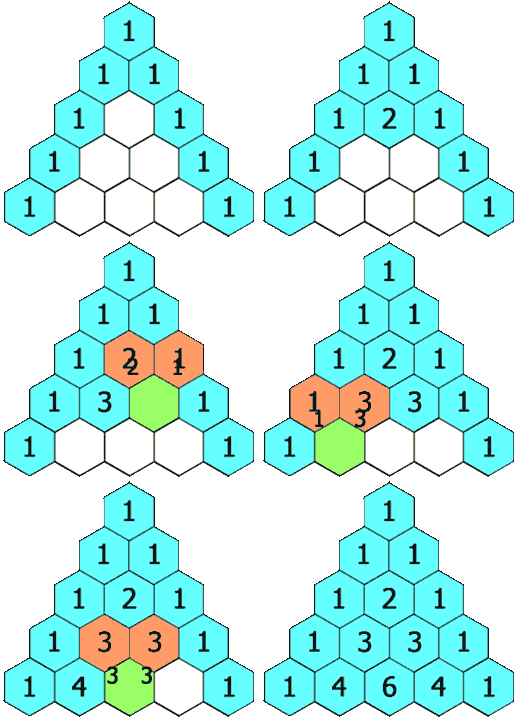
Example 1:
Input: numRows = 5

Output: [[1],[1,1],[1,2,1],[1,3,3,1],[1,4,6,4,1]]
Example 2:
Input: numRows = 1

Output: [[1]]
Constraints:
1 <= numRows <= 30
Topics
Prerequisites
Before attempting this problem, you should be comfortable with:
- Dynamic Programming - Building each row using values from the previous row
- 2D Arrays - Storing and accessing the triangle structure
- Combinatorics - Understanding that each element is a binomial coefficient C(n, k) and can be computed incrementally
1. Combinatorics
Intuition
Each element in Pascal's Triangle corresponds to a binomial coefficient. The value at row n and position k is C(n, k). Rather than computing each coefficient from scratch using factorials, we can compute them incrementally. Starting from 1, each subsequent value in a row can be derived by multiplying by (n - k + 1) / k.
Algorithm
- Initialize an empty result list.
- For each row
nfrom0tonumRows - 1:- Start the row with
[1]. - Set
val = 1. - For each position
kfrom1ton:- Compute
val = val * (n - k + 1) / k. - Append
valto therow.
- Compute
- Add the completed
rowto the result.
- Start the row with
- Return the result list.
Time & Space Complexity
- Time complexity:
- Space complexity:
2. Dynamic Programming - I
Intuition
Each element in Pascal's Triangle (except the edges) is the sum of the two elements directly above it. We can simulate this by padding the previous row with zeros on both ends, then summing adjacent pairs to generate the next row.
Algorithm
- Start with the first row
[[1]]. - For each subsequent row:
- Take the last row and pad it with zeros:
[0] + row + [0]. - Create a new row by summing adjacent elements:
temp[j] + temp[j + 1]. - Append the new
rowto the result.
- Take the last row and pad it with zeros:
- Return the result after generating
numRowsrows.
Time & Space Complexity
- Time complexity:
- Space complexity:
3. Dynamic Programming - II
Intuition
We directly apply the defining property of Pascal's Triangle: each interior element equals the sum of the two elements above it. The first and last elements of every row are always 1. We build row by row, referencing the previous row for the sums.
Algorithm
- Initialize a 2D list where row
ihasi + 1elements, all set to1. - For each row from index 2 onward:
- For each interior position
j(not the first or last):- Set
res[i][j] = res[i - 1][j - 1] + res[i - 1][j].
- Set
- For each interior position
- Return the completed triangle.
Time & Space Complexity
- Time complexity:
- Space complexity:
Common Pitfalls
Off-by-One Errors with Row Indexing
Pascal's Triangle is often 0-indexed, so row 0 is [1], row 1 is [1, 1], and so on. Confusing 0-indexed and 1-indexed row numbering leads to generating one too many or one too few rows. Always clarify whether numRows means the count of rows or the index of the last row.
Forgetting Edge Elements Are Always 1
The first and last elements of every row are always 1. When building rows iteratively, only the interior elements (positions 1 through i-1 for row i) need to be computed as sums. Attempting to compute edge elements using the sum formula causes index-out-of-bounds errors.
Sign in to join the discussion